Aspen Blue Koreny-Crawford – CS 499 ePortfolio
Backend-focused developer building scalable data systems, secure database architectures, and performance-driven applications.
Technical Focus
- Database Architecture (MongoDB)
- Secure Data Access Layers
- Aggregation & Data Processing
- API-Driven Design
Welcome to my Computer Science Capstone ePortfolio.
This portfolio demonstrates growth across:
- Software Design and Engineering
- Algorithms and Data Structures
- Databases
Professional Self-Assessment
This self-assessment reflects on my growth throughout the Computer Science program and how I am positioning myself professionally.
Click to read my full self-assessment
Completing the Computer Science program and developing my professional ePortfolio has allowed me to clearly define my technical interests, identity, and professional direction. Through structured coursework and applied projects, I have developed into a backend-focused developer with a strong foundation in database architecture, algorithm optimization, and secure system design. What began as broad curiosity about technology evolved into a focused interest in scalable data systems and the architectural decisions that support long-term maintainability and security.
Throughout the program, I have learned that strong software development is not only about writing code but about building systems that serve real organizational needs. My selected artifact for the SNHU CS capstone ePortfolio, the Grazioso Salvare Animal Rescue Dashboard, represents that thinking. Initially created during my time in CS 340 Client/Server Development, it began as a functional database-driven dashboard. Through the capstone process, I enhanced this artifact across software design, algorithms and data structures, and database architecture. Each enhancement was deliberate and iterative, reflecting the same mindset I apply in my current professional roles as a recruiter working with HR systems and reporting tools, and future opportunities.
Being able to articulate my thoughts and steps of processes well has been a central theme in my academic and professional growth, as collaboration and communication are key in the professional world. In my current career as a talent acquisition specialist, I work closely with systems administrators and stakeholders to improve reporting workflows and data processes. Translating technical details into accessible explanations for non-technical users has become one of my strengths. This capability is reflected in my structured code review and written narratives, where I explain not only what changes were implemented but why they were necessary. Conducting a structured code review reinforced the importance of clarity, documentation, and constructive evaluation within collaborative environments. These practices support informed decision-making for stakeholders and align with industry expectations for peer review and professional communication.
From an algorithmic perspective, I strengthened my ability to design and evaluate computing solutions, using appropriate data structures and performance trade-offs. In my second enhancement, I moved aggregation logic from the application layer to MongoDB using an aggregation pipeline. This change reduced redundant computations, improving scalability. More importantly, it demonstrated my understanding of algorithm placement and performance implications. Designing solutions requires evaluating trade-offs among simplicity, efficiency, and maintainability. By relocating data grouping and counting operations to the database layer, I improved system efficiency while simplifying the application logic. This experience reinforced my confidence in analyzing performance bottlenecks and selecting implementation strategies grounded in computer science principles.
The software design enhancement focused on modularization, separation of concerns, and structural clarity. Refactoring the codebase improved readability and maintainability while better aligning with software engineering best practices. I approached these modifications using an iterative development mindset similar to the software development lifecycle discussed throughout the program. Each enhancement was planned, implemented, tested, and refined. This process reflects my ability to use well-founded tools and techniques to deliver practical improvements rather than surface-level changes. The result is a cleaner, more professional codebase that reflects production-minded thinking.
Enhancing the database has significantly improved my security awareness and my ability to make architectural decisions. Instead of exposing the full Create, Read, Update, and Delete (CRUD) functionality through the user-facing dashboard, I have separated administrative database operations into a distinct command-line tool. This design adheres to the principle of least privilege. Additionally, I have externalized the database configuration by using environment variables, rather than hardcoding credentials. These changes reflect a developing security mindset that anticipates misuse, reduces the attack surface, and prioritizes long-term maintainability.
Beyond the artifact itself, the entire program experience has helped me think critically about backend systems and data-driven decision-making. My work as a recruiter involves analyzing hiring data, improving reporting processes, and collaborating with HR systems administrators on workflow initiatives. The technical skills developed in this program — database querying, algorithm optimization, modular system design, and secure configuration — directly support those responsibilities and expand my ability to contribute in more technical capacities. I now approach data systems not only as a user but as a builder who understands the infrastructure behind them.
Together, these enhancements demonstrate cohesive technical growth. Rather than selecting unrelated projects, I chose to deepen and expand a singular artifact across multiple dimensions. This approach allowed me to demonstrate layered improvement throughout this capstone, including structural refinement, performance optimization, and security hardening.
With my experience using HR systems and collaborating with administrators, I am particularly interested in backend development and data systems roles involving database architecture, analytics platforms, or system optimization. I aim to continue strengthening my understanding of distributed systems and scalable architecture while maintaining a security-conscious perspective.
Ultimately, this portfolio integrates my technical skills, professional experience, and intentional growth. It demonstrates my ability to communicate clearly, design efficient solutions, apply industry-standard practices, and develop systems with a security mindset.
Professional Self-Assessment
Informal Code Review
As the foundation for this capstone, I conducted a structured peer-style code review of my original Grazioso Salvare Animal Rescue Dashboard to identify architectural improvements across software design, algorithm efficiency, and database security.
Watch the Code Review Video:
View Code Review on YouTube
Read the Code Review Summary:
Code Review Documentation
Artifact Source Files
The original CS 340 implementation and the enhanced CS 499 version are preserved below to demonstrate architectural refactoring, algorithmic improvements, and database security enhancements.
Original Artifact (CS 340 Version)
Enhanced Artifact (CS 499 Capstone Version)
Artifact Enhancement Narratives
- Software Design & Engineering Enhancement
- Algorithms & Data Structures Enhancement
- Database & Security Enhancement
Interactive MongoDB + Dash Data Visualization Dashboard
The enhanced Grazioso Salvare dashboard integrates MongoDB data retrieval, aggregation pipelines, and Plotly visualizations into an interactive analytics interface.
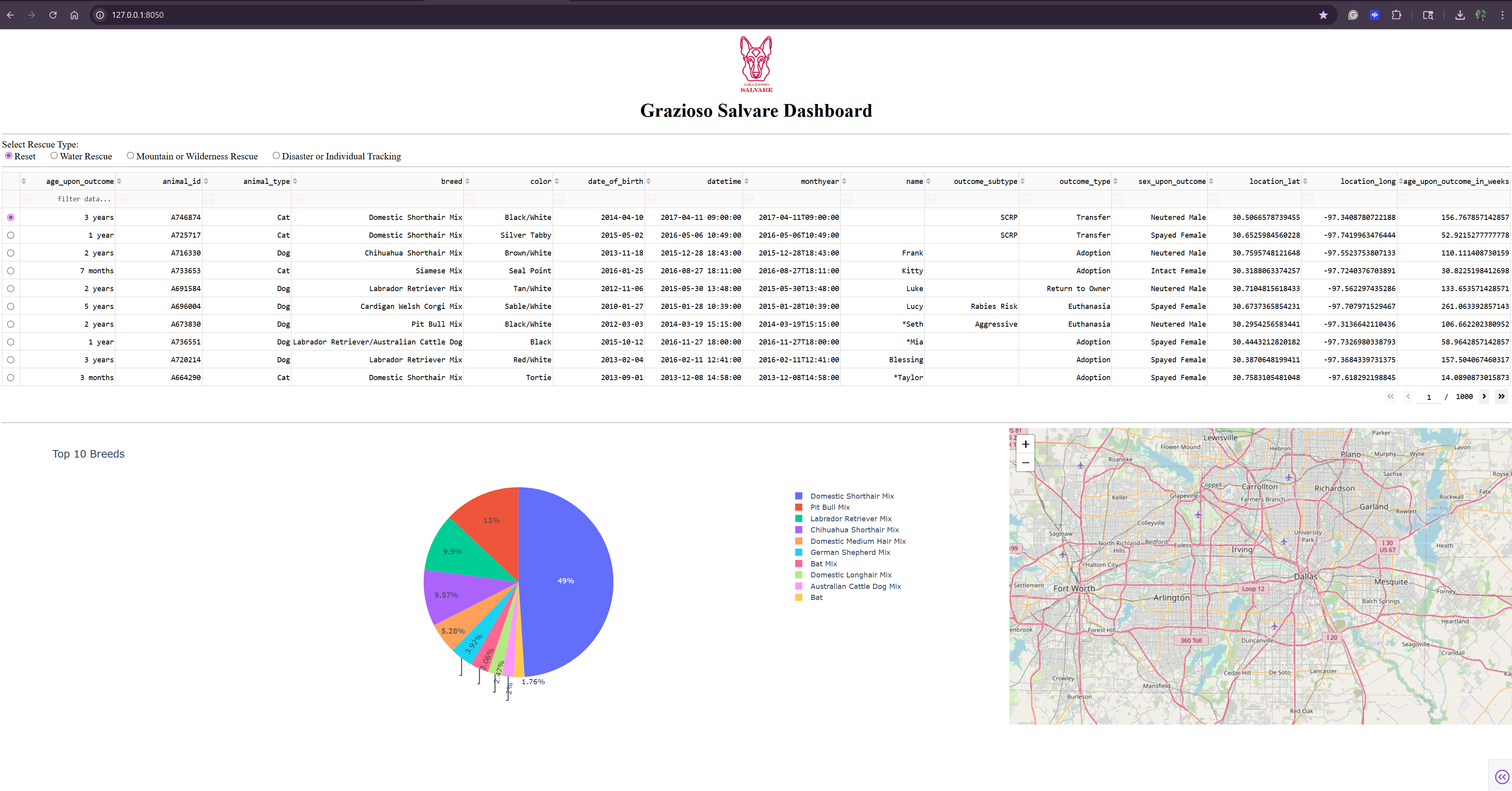
Tech Stack: Python · MongoDB · Dash · Plotly · Aggregation Pipelines
This portfolio represents the integration of structured computer science education, applied backend development, and intentional professional growth.